Your Baby's First Year (3-12 Months): A Guide From First Solids and First Tooth to First Steps
A guide to caring for your baby from 3 to 12 months: starting solids at 6 months, sleep around 4 months, Pink Book vaccines, teething, milestones at 6, 9 and 12 months, baby-proofing for crawling, and signs to go to the hospital.

You made it through the first 3 months. Congratulations. The stretch where everything was new, feeding, poop, pee, the cord stump, jaundice, is behind you. Now your baby is starting to smile and babble, and is about to enter a phase that changes so fast it’s hard to keep up.
From 3 to 12 months, a lot of big moments are waiting: the first spoonful of rice, the first tooth, the nights when your baby starts waking again, the day they crawl straight to an outlet, and the first step the whole family is waiting for. We’ve gathered everything onto one page, and each section links to a deeper read. Take it one section at a time as your baby grows.
What does my baby really need from me in the first year?
Quick Answer: Five main things: enough milk and solids when the time comes, safe sleep, vaccines on schedule, a home safe enough to explore, and someone who plays and talks with them every day.
When you’re exhausted, come back to this table. If these 5 are OK, the rest is detail.
| Topic | In short | Read more |
|---|---|---|
| Feeding | Milk is the main food all year, start solids at 6 months | When can babies start solids? |
| First meals | Mashed rice, cooked egg yolk, fish, liver, pumpkin, no seasoning | Baby’s first meal |
| Sleep | On the back, flat surface, nothing soft, may wake more around 4 months | 4-month-old waking often |
| Vaccines | Visits at 4, 6 and 9 months and 1 year, per the Pink Book | First-year vaccines |
| Teeth | First tooth usually around 6 months, no numbing gels or amber necklaces | Teething fussiness |
| Development | Use the checklist, but it’s not a test | 6-month milestones |
| Safety | Baby-proof before your baby crawls | 10 baby-proofing spots |
What should a 3 to 12-month-old eat, and when do solids start?
Quick Answer: From 3 to 6 months, breast milk or formula only. Start solids once your baby turns 6 months, then gradually add meals until they’re having 3 a day by 10 to 12 months, with milk still the main food all year.
Thailand’s Department of Health recommends breast milk only until 6 months, with no water, then starting solids alongside breast milk until 2 years or longer. The World Health Organization (WHO) gives a rough number of meals like this:
| Age | Solid meals (WHO) | Texture |
|---|---|---|
| 3 to 6 months | None yet, milk only | |
| 6 to 8 months | 2 to 3 a day (start with 1) | Smooth, then gradually lumpier |
| 9 to 11 months | 3 to 4 a day | Finely chopped, soft finger foods |
| Around 12 months | Family food (no added salt or sugar) | Soft, small pieces |
The most common belief at this stage is “Give mashed banana at 3 to 4 months so they stay full longer.” Thailand’s Department of Health warns that giving banana or other foods to babies under 6 months risks bloating, constipation, food allergy and intestinal blockage. The full reasons, and the signs your baby is really ready, are in Mashed banana at 4 months? Why doctors say wait until 6 months.
When the day comes, a Thai kitchen has everything you need: mashed rice, fully cooked egg yolk, mackerel, chicken liver, pumpkin and ivy gourd. No salt, fish sauce or sugar, and no honey before age 1. Week-by-week menu ideas are in Baby’s first meal: rice, egg yolk or vegetables?.
If your baby is bottle-fed, see the options at Best baby bottles, and if you’re still worried about milk supply, look back at Signs your baby is getting enough breast milk.
How should my baby sleep, and why do they wake more around 4 months?
Quick Answer: Always put your baby on their back on a firm, flat mattress with no pillows, blankets or soft toys, and share a room but not a bed for at least the first 6 months. Waking more around 4 months is usually because sleep patterns are changing.
The AAP’s safe sleep rules still apply throughout the first year:
- Always on the back. If your baby rolls comfortably both ways on their own, you don’t need to keep turning them back
- Stop swaddling once your baby shows signs of rolling, usually around 3 to 4 months
- A firm, flat mattress with no pillows, blankets, bumpers or toys
- Same room, separate bed for at least the first 6 months, and don’t fall asleep on a sofa with your baby
- Don’t overbundle. Dress your baby in about one layer more than an adult, which in a hot Thai home often means no extra cover at all
Around 4 months, many families find their baby, who used to sleep long stretches, is back to waking every 2 hours. That doesn’t mean your baby is going backwards. Their sleep is changing to include more light sleep, and it usually improves within days to a few weeks. How to cope, and how to tell it apart from illness, is in 4-month-old waking every 2 hours.
If your family bed-shares, read Bed-sharing with your newborn: 7 checks to lower the risk as much as possible.
Is my baby on track? Milestones at 4, 6, 9 and 12 months
Quick Answer: Use the CDC checklists, which show what most children (75% or more) can do. For example, at 6 months rolling from tummy to back and sitting leaning on hands, at 9 months sitting alone and looking when you call their name, at 1 year pulling up to stand and walking while holding furniture.
A short summary of the CDC checklists:
| Age | Examples most babies can do |
|---|---|
| 6 months | Knows familiar people, laughs, takes turns making sounds, grabs things and mouths them, rolls tummy to back, sits leaning on hands |
| 9 months | Shy or fearful with strangers, looks when you call their name, babbles mamamama and bababababa, lifts arms to be picked up, looks for things dropped out of sight, gets to sitting alone and sits without support |
| 1 year | Plays pat-a-cake, waves bye-bye, calls “mama,” “dada” or a special name, understands “no,” pulls up to stand, walks holding furniture, picks up small things between thumb and pointer finger |
Notice that the CDC’s 1-year checklist doesn’t include “walks alone.” If a friend’s baby walked at 10 months and yours is just pulling up at 1 year, yours is still on track.
In Thailand, the Ministry of Public Health screens development using the DSPM manual at 9, 18, 30, 42 and 60 months, but you can raise concerns at any visit without waiting for a screening round. The CDC stresses that if your baby could do something and now can’t, don’t wait. Talk to the doctor.
The full 6-month checklist with tick boxes to bring to your appointment is in Half a year old: 6-month milestones checklist.
The best way to support development doesn’t require anything expensive. Talk to your baby all day, describe what you’re doing, read stories, sing, play peekaboo, give tummy play on a mat while awake, and let them crawl and explore on a safe floor, instead of sitting in a walker or watching screens.
Which vaccines are given in the first year?
Quick Answer: The main visits are 4 months (DTP-HB-Hib, IPV, rotavirus), 6 months (DTP-HB-Hib, oral polio, rotavirus if the 3-dose type), 9 months (MMR) and 1 year (Japanese encephalitis). PCV is free from 1 October 2026 at 2, 4 and 12 months.
This year brings good news on the pneumococcal vaccine (PCV). According to Hfocus, Thailand’s National Health Security Board made PCV a benefit for children aged 2 to 12 months, effective 1 October 2026, with 3 doses. Availability may not be the same at every hospital yet, so ask at your next visit.
The question moms ask most is, “My baby was sick and we missed the appointment. Do we start over?” No. Get the missed dose as soon as possible. The exception is rotavirus, which has age limits. The full schedule, optional vaccines and after-shot care are in First-year vaccines in the Pink Book, and for birth to 2 months, see Your baby’s first vaccines.
Bring the Pink Book to every visit, both vaccine and check-up visits, so the nurse records weight, height and vaccines each time. This book is your baby’s health record, usable at any hospital.
When does the first tooth come, and how do I help a teething baby?
Quick Answer: The first tooth usually arrives around 6 months, but timing varies a lot. Help with gum massage, a firm teether that isn’t frozen, or a cold cloth, and avoid benzocaine numbing gels and all teething necklaces.
Teething makes babies fussy, drooly and eager to chew everything. But here’s what’s worth knowing: medical sources like the NHS and AAP say teething doesn’t cause a high fever or diarrhea. If your baby has a fever of 38°C or higher, or diarrhea, look for another cause first instead of assuming it’s “just teeth.”
What works, what to avoid and when to call the doctor are in Teething fussiness all day: what’s safe and actually helps.
My baby is starting to crawl. How do I prepare the home?
Quick Answer: Get down to your baby’s eye level and secure the risky spots first, especially windows and balconies, medicines and cleaners, water in buckets and basins, button batteries and furniture that can tip.
Between 6 and 12 months, babies roll, crawl, pull up and put everything in their mouths. A home that was safe for a baby lying still becomes an exploration zone overnight. Deal with these first:
- Windows and balconies, especially in condos. Lock them to open only a little and move anything climbable
- Medicines, balms and cleaning products up high or in a locked cupboard
- All water. Buckets, basins, tubs: empty them after use. Babies can drown in very shallow water
- Button batteries in remotes and car keys, out of reach
- Hot things: hot water flasks, rice cookers, coffee cups
The full 10-spot checklist with tick boxes and emergency numbers is in Your baby is crawling: 10 spots to secure. For trips out, see Best newborn car seats and Best lightweight strollers.
My baby is sick in the first year. How much can I manage at home?
Quick Answer: A mild cold where your baby still feeds, plays and pees normally can usually be managed at home. But trouble breathing, drowsiness, refusing milk, fewer wet diapers, or any fever in a baby under 3 months means going to the hospital.
After 6 months, the immunity your baby got from you at birth gradually fades, they meet more people and put more things in their mouth, so getting sick more often is common. The best way to judge how sick they are is to look at “your baby” rather than just the thermometer.
| Manage at home and keep watching | See the doctor |
|---|---|
| Feeding close to normal | Feeding much less or refusing |
| Regular wet diapers | Fewer wet diapers, dry mouth, crying without tears |
| Plays again once the fever comes down | Drowsy, not playing, even when the fever is down |
| Normal breathing | Fast breathing, chest pulling in, wheezing |
For fever medicine, always ask a doctor or pharmacist about the right type and dose for your baby’s weight. If your baby is under 3 months, read Fever in babies under 3 months: why doctors say come straight in. Families in Chiang Mai can keep the list of Pediatric hospitals and clinics in Chiang Mai handy.
What about mom? Looking after yourself in the first year
Quick Answer: The first year is physically and emotionally exhausting. Share night shifts with someone at home, eat and sleep when you can, and if you feel sad, hopeless or unable to cope for several days, tell the doctor or call Thailand’s mental health hotline 1323.
Many moms go back to work in this period, juggling pumping, finding childcare and coping with nights when the baby still wakes. If you still have leave left, check your rights at Maternity leave rights in Thailand, and if you’re planning a trip abroad with your baby, get documents ready early with Getting a passport for your baby.
Also brace yourself for lots of advice from the grandparents: mashed banana, teething fevers, bundling up. Some advice has its reasons, and some is based on knowledge that has since changed. Read how to talk about it without arguing at Mom myths: which are true?.
Go to the hospital now if…
Quick Answer: Trouble breathing, drowsiness or being hard to wake, seizures, refusing milk, choking and unable to breathe, swallowing a button battery or poison, or any fever in a baby under 3 months: go to the hospital right away or call 1669.
- Trouble breathing, fast breathing, chest pulling in, blue lips
- Drowsy, hard to wake, floppy, or a high-pitched cry that won’t stop
- Seizures or jerking
- Refusing several feeds in a row, much less pee, dry mouth
- Fever of 38°C or higher in a baby under 3 months, or fever with a rash of blood spots that doesn’t fade when pressed
- A bulging, tight soft spot
- Choking, can’t cough, can’t breathe, turning blue
- Suspected swallowing of a button battery, magnet or poison (get advice from the Ramathibodi Poison Center on 1367)
- A fall from a height followed by drowsiness, repeated vomiting, or bleeding from the ear or nose
- Swelling of the lips, tongue or face, or wheezing after a new food or a vaccine
- Repeated vomiting, episodes of screaming with legs pulled up to the tummy, or blood in the stool
Stick 1669 and 1367 on the fridge, and make sure everyone who helps look after your baby knows them.
The first year in a nutshell
Quick Answer: Milk is the main food all year, start rice at 6 months, back to sleep on a flat surface, keep the vaccine appointments in the Pink Book, baby-proof before crawling, talk and play every day, and know the danger signs.
- 3 to 6 months: milk only, back to sleep, stop swaddling once your baby starts rolling, ride out the sleep shift around 4 months, 4-month vaccines
- 6 months: start solids, the first tooth may come, 6-month vaccines, check milestones
- 6 to 9 months: lumpier food, more meals, crawling begins, finish baby-proofing
- 9 months: MMR vaccine and developmental screening
- 9 to 12 months: food close to family meals, pulling up and cruising, 1-year vaccines
If your baby is under 3 months, look back at Your baby’s first 3 months: a guide for new moms.
The first year goes faster than you think. On the day your baby blows out their first candle, you’ll look back and hardly believe you made it through all of this. However tired you are, know that you’re doing really well.
In this section
 Your Baby Is Crawling: Look at Your Home From Their Eye Level, 10 Spots to Secure Before Something Happens
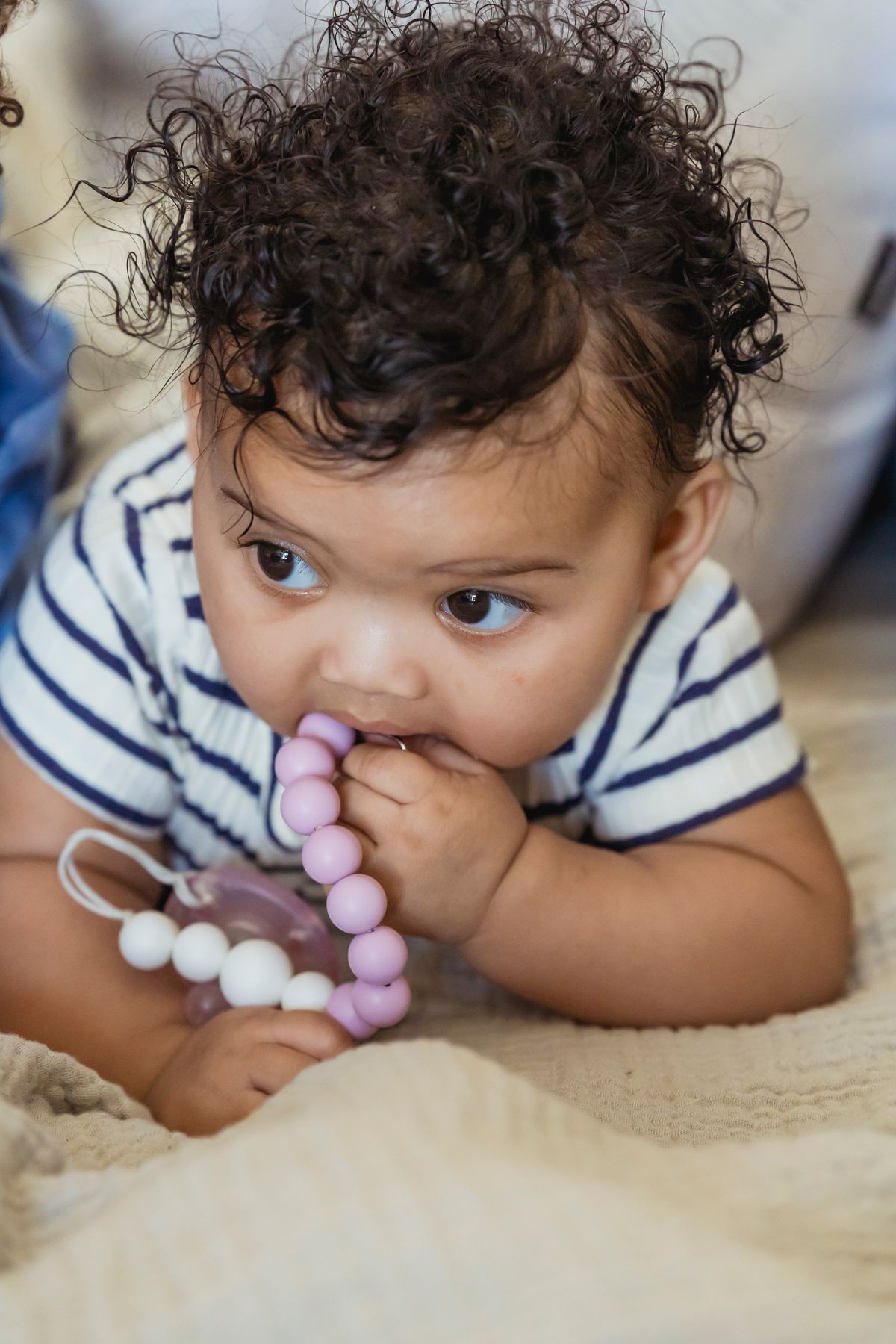 Teething Fussiness All Day: Teethers, Gum Gels or a Cold Cloth, What's Safe and Actually Helps
 Half a Year Old: A 6-Month Milestones Checklist, Plus Signs to Mention at the Vaccine Visit
 Baby's first meal: mashed rice, egg yolk or veggies? Simple Thai home-style first food ideas
 Sleeping Long Stretches, Then Waking Every 2 Hours at 4 Months? Your Baby Isn't Going Backwards, Their Sleep Is Growing Up
 First-Year Vaccines in the Pink Book: Which Are Free, Which Are Optional, and Do You Restart If You Miss One?
 Getting a Thai Passport for a Baby Under 1: Do Both Parents Need to Go, and How to Get a Photo That Passes
 Mashed Banana at 4 Months? Why Pediatricians Say Wait Until Around 6 Months, and the Signs Your Baby Is Really Ready
Questions parents ask
01What do I need to take care of for a baby aged 3 to 12 months?
The main things are milk and starting solids at 6 months, safe sleep, vaccines from the Pink Book, teething, tracking development, and baby-proofing when your baby starts crawling, along with knowing the danger signs that mean going to the hospital.
02At what age can babies start eating rice?
At 6 months, as recommended by Thailand's Department of Health and the World Health Organization. Before that, breast milk only, with no water or mashed banana.
03When are vaccines given in the first year?
The main appointments on the routine schedule are at 2, 4, 6 and 9 months and 1 year. PCV became a free benefit from 1 October 2026, given at 2, 4 and 12 months. Go by the appointments in your Pink Book.
04Should my baby be walking by 1 year?
Not necessarily. The CDC's 1-year checklist only looks for pulling up to stand and walking while holding on to furniture. Walking alone often comes after that for many children.
05What should a 9-month-old be able to do?
According to the CDC, most 9-month-olds sit without support, get into a sitting position by themselves, look when you call their name, are shy around strangers, babble sounds like mamamama and bababababa, and look for things dropped out of sight.
06Is it normal for a baby to wake often at night in the first year?
Very common, especially around 4 months when sleep patterns change, and many babies still wake at night at 12 months. If your baby is feeding well and growing along the curve, it's usually not a worry.
07When should I take my baby to the hospital for a fever in the first year?
Go right away if fever comes with drowsiness, being hard to wake, trouble breathing, seizures, refusing milk, a rash of blood spots, or a bulging soft spot. If your baby is under 3 months, a fever of 38°C or higher means going to the hospital even if they seem well.
Can't find what you're looking for?
Ask us anything about family life in Thailand. No name needed. We read every question, and the ones parents ask most become new guides.
