2-year-old milestones: the pink book checklist many families forget to open
Most 2 year olds run, kick a ball, stack 4 blocks, use a spoon and put two words together. The full 5-area checklist from the DSPM guide in Thailand's pink book, with play ideas and what to do if items aren't there yet.
Where’s that pink book right now? In the vaccine document folder, in a desk drawer, or under a pile of storybooks? Lots of families only open the vaccine table page and close it again, even though inside is one of the most detailed, genuinely useful development checklists Thai moms have.
We’ll sum up what your child should be doing around age 2 according to the DSPM guide, area by area, with simple play ideas, and what to do next if some items aren’t there yet. Tick off the checklist above as you go.
1. Why open the pink book when your child is 2?
Quick Answer: Because 18 to 30 months is when language and self-help skills change fastest, and it’s when the Ministry of Public Health screens development. If something is slow, spotting it early means helping early.
The Ministry of Public Health screens early childhood development at 5 ages: 9, 18, 30, 42 and 60 months. So age 2 falls right between the 18-month and 30-month checks. In between, parents can use DSPM at home.
DSPM splits development into 5 areas: gross motor (GM), fine motor and thinking (FM), understanding language (RL), using language (EL), and self-help and social skills (PS). The nice thing is each item comes with play activities to build it, not just a pass or fail box.
2. Gross motor: running, kicking, jumping
Quick Answer: At 19 to 24 months your child should swing a leg to kick a ball, and at 25 to 29 months jump with both feet leaving the ground.
The 18-month record already includes “runs”. The CDC also says most 2 year olds run, kick a ball, and walk up a few stairs, with or without help.
Play ideas
- Roll a ball for your child to kick back, using a light plastic ball, or set up empty water bottles as bowling pins
- Play jump-like-mommy, or jump over a line of tape on the floor
- Walk on grass, at the park, up and down ramps
3. Fine motor and thinking: stacking, grabbing, problem-solving
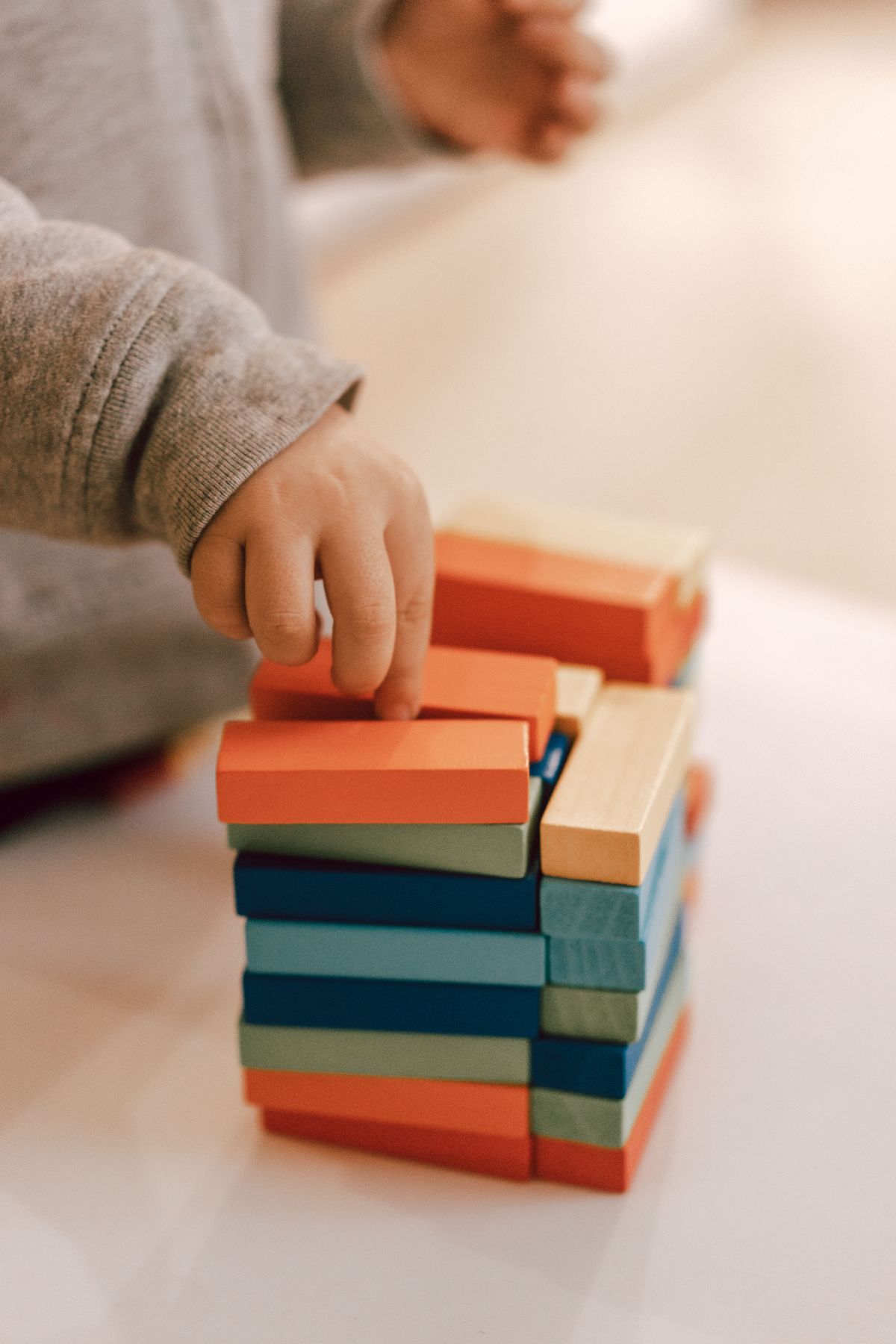
Quick Answer: At 19 to 24 months your child stacks 4 blocks. At 25 to 29 months they solve simple problems with a tool, like using a stick to reach something out of reach.
The CDC adds that 2 year olds often hold something in one hand while using the other, like holding a container and taking off the lid, try buttons or knobs on toys, and play with several toys at once, like putting toy food on a plate.
Play ideas
- Build towers from milk cartons, wooden blocks or stacking cups, then let your child knock them down (they love it)
- Let them open and close plastic lunch boxes, fill them and tip them out
- Put a toy under a table out of reach, and let your child work out how to get it
4. Understanding language: listening, pointing, following
Quick Answer: At 19 to 24 months your child picks the right object on request from a choice of 4. At 25 to 29 months they point to 7 body parts.
Understanding almost always comes before talking. Some children say little but understand a lot, so this item really matters in a doctor’s assessment. The CDC says 2 year olds should point to things in a book when asked, like “Where’s the bear?”, and point to at least 2 body parts.
Play ideas
- Put 4 things on the floor, like a spoon, cup, doll and car, and say “Pass mommy the cup, please.”
- Sing a body parts song, eyes, ears, nose, mouth, at bath time
- Read picture books, pointing and asking, “Where’s the cat?”, “Who’s eating?”
5. Using language: from single words to phrases
Quick Answer: At 19 to 24 months your child copies a two-word phrase. At 25 to 29 months they can say yes and no, like “want” and “don’t want”.
The AAP says most 2 year olds say about 50 to 100 words, start using two-word phrases like “daddy go” or “all gone”, and are understood by others about half the time. If your child only says a few words, read what doctors look at in My 2 year old only says a few words: wait, or see a developmental doctor?
Play ideas
- Stretch their words: your child says “car”, you say “red car, car goes”
- Ask choice questions: “Banana or papaya?” instead of “Do you want some?”
- Sing a song and leave out the last word for your child to fill in
6. Self-help and social: eating alone, washing hands
Quick Answer: At 19 to 24 months your child feeds themselves with a spoon. At 25 to 29 months they wash and dry their own hands.
This is the area where adults “help too much” most often. Every time your child feeds themselves, rice ends up all over the floor, and spoon-feeding is so much faster. But if your child never gets to practice, they won’t pass this item, even though nothing is wrong at all.
Play ideas
- Let your child hold the spoon for at least half the meal. Put a cloth or newspaper under the chair and make peace with the mess.
- Put a small stool in front of the sink and wash hands together, singing as you go
- Give small household jobs: toys into the basket, clothes into the laundry basket
If you’re about to start potty training too, these self-help skills all connect. Read Potty training: what age is ready?
7. What if some items aren’t there yet?
Quick Answer: No need to panic. The Ministry of Public Health approach is for parents to practice using the guide’s activities, then re-check within 30 days. If it’s still not there, the child is referred for a detailed assessment and developmental stimulation.
What usually happens when screening shows “suspected delay”:
- Staff explain how to build the skills your child didn’t pass, for parents to do at home
- A re-check within 30 days
- If still not passed, a referral to a larger hospital for assessment and stimulation using a specialist guide (TEDA4I), with ongoing follow-up
- If there’s clearly a problem from the start, an immediate referral
Meanwhile, if your child also talks very little, ask the doctor for a hearing test too. The AAP recommends it as a first check when a child is late to talk.
8. See a doctor soon if…
Quick Answer: If skills your child had have disappeared, they don’t turn to their name, don’t point, avoid eye contact, aren’t putting two words together at 2, or still walk unsteadily, book a doctor’s visit without waiting for the next screening age.
Book a doctor’s visit soon if your child:
- Has lost skills or words they used to have
- Doesn’t turn to their name, make eye contact, or point to ask for or show things
- Is 2 and still doesn’t put two words together or understand simple instructions
- Is 2 and still walks unsteadily, falls very often, or clearly uses only one hand all the time
- Can’t do several pink book items, or still can’t after 1 month of practice
- Has repetitive unusual behaviors, like hand flapping, spinning, or no interest in people around them
Go to hospital now if your child suddenly becomes weak, suddenly can’t walk, has a seizure, or is unusually drowsy.
Your child doesn’t need to tick every item on the day they reach that age. The pink book isn’t there to stress moms out. It’s there to help us keep up with our child and know what to play with them. For the big picture on development and everything else at this age, see Raising a 1 to 3 year old: the complete guide.
Checklist (tick and print)
Tick away, this device will remember.
19 to 24 months (DSPM guide)
25 to 29 months (DSPM guide)
30 months (screening age at the well-child clinic)
Some example items from the record form. See every item in your child's pink book.
Questions parents ask
01What should a 2 year old be able to do?
According to the DSPM guide, at 19 to 24 months your child should kick a ball, stack 4 blocks, pick the right object on request from a choice of 4, copy a two-word phrase, and feed themselves with a spoon.
02What is DSPM?
DSPM is Thailand's early childhood development surveillance and promotion guide, found in the pink book. Parents use it to check development in 5 areas by age, and it has play activities to build each skill.
03Where can I get a free developmental check, and at what age?
The Thai Ministry of Public Health screens child development at 5 ages: 9, 18, 30, 42 and 60 months, at the well-child clinic of a public hospital or local health center, under your child's coverage. It's usually done alongside vaccine or check-up visits.
04My 2 year old can't do 1 item in the pink book. Is that abnormal?
Not necessarily. The Ministry of Public Health approach is for parents to practice using the guide's activities, then re-check within 30 days. If it's still not there, staff refer the child for a detailed assessment.
05My 2 year old isn't running yet. Should I worry?
Most children can run from about 18 months. If at 2 your child still walks unsteadily, falls very often, or can't run, talk to a doctor to check their muscles and development.
06My child talks very little but can do everything else. What should we do?
Encourage talking at home every day, and see a doctor for a hearing test and a language-focused assessment, especially if your child isn't putting two words together at 2.
Can't find what you're looking for?
Ask us anything about family life in Thailand. No name needed. We read every question, and the ones parents ask most become new guides.