When Does Your Baby's First Real Smile "For Mom" Come, and How Is It Different From Sleep Smiles?
Sleep smiles in month one are reflexes. A social smile, when baby smiles back at you, usually comes at 6 to 8 weeks and is clear by 2 months. How to tell, how to coax one, when to tell the doctor.
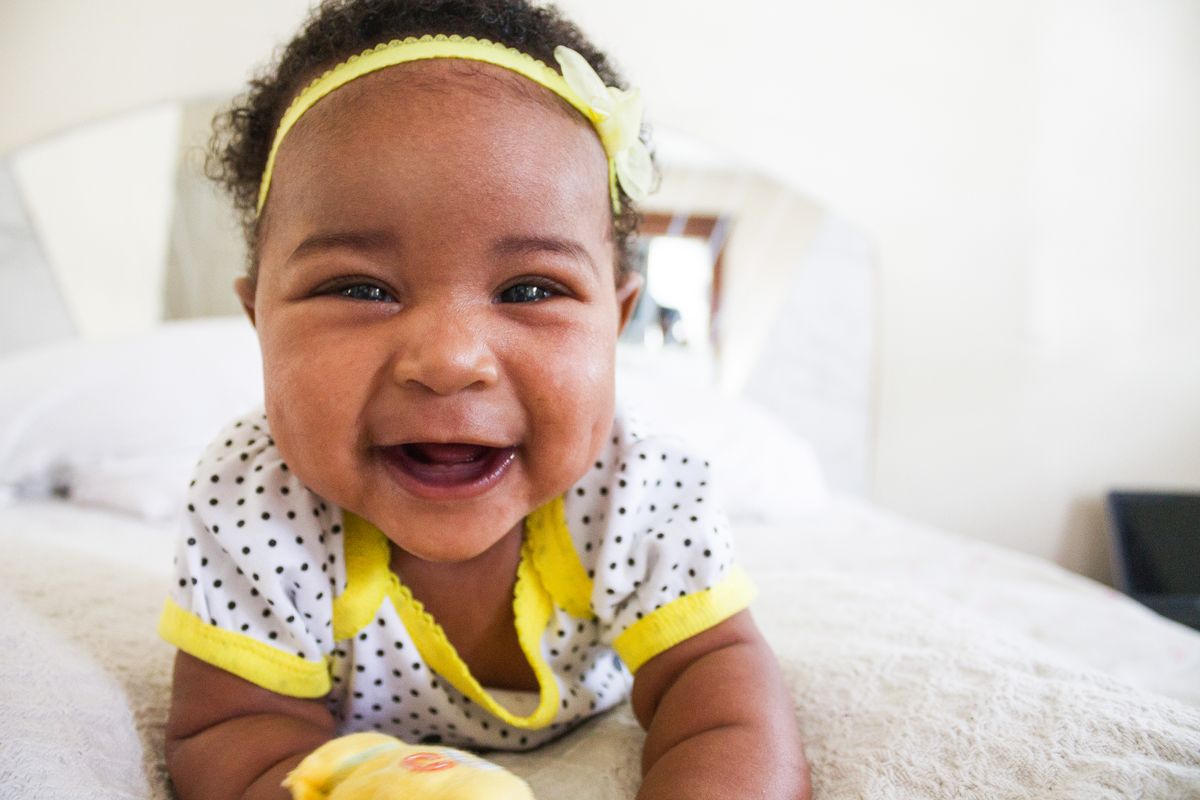
It’s 4 a.m. Your baby is asleep in your arms, and suddenly breaks into a big smile. Your heart melts. Then the questions come right away: was that smile for me? Grandma says “the mae sue are playing with the baby” (in Thai folk belief, mae sue are spirit mothers who watch over newborns), while a friend says “it’s just wind.” So which is it?
Here’s the answer up front: the early smiles and the smile your baby “means for you” are two different things. Let’s help you tell them apart, when real smiles usually arrive, and when to mention it to your doctor.
What are sleep smiles in the first month?
Quick Answer: They’re reflex smiles the body makes without meaning to, usually during sleep or after a full feed. Your baby isn’t smiling back at anyone yet.
Cleveland Clinic explains that this kind of smile is a newborn reflex, made automatically by the body. Pathways.org says reflex smiles are usually brief and random, like when a baby is sleeping, and aren’t caused by anything in front of them.
As for the mae sue story the elders tell, it’s how older generations explained how sweet babies are. It’s actually rather heartwarming. No need to argue about it. Just know quietly that, medically, newborn sleep smiles are a very normal reflex.
When does a real smile, meant for mom, come?
Quick Answer: The social smile usually starts at about 6 to 8 weeks, and AAP says it’s usually seen by the end of month 2.
- Pathways.org: real smiles usually start at about 6 to 8 weeks, around the same time reflex smiles gradually disappear at about 2 months
- Cleveland Clinic: at about 8 weeks, babies start smiling back when you talk or smile at them
- CDC lists “smiles when you talk to or smile at them” as a 2-month milestone, meaning something most children (75% or more) can do by that age
Simply put, some babies smile earlier and some a little later, and both are perfectly normal.
How to tell which smile is the real one
Quick Answer: A real smile happens when your baby is awake, looking at your face, and smiling in response to something you do. Reflex smiles usually happen during sleep or drowsiness, for no reason.
| Reflex smile | Social smile (real smile) |
|---|---|
| Can be seen from birth | Usually starts at about 6 to 8 weeks |
| During sleep, drowsiness or after a feed | When awake, eyes open, looking at your face |
| Happens on its own, randomly, briefly | Happens after you talk, smile or make sounds |
| Can’t be repeated when you try | Try again and your baby usually smiles back again |
To find out, try this: when your baby is awake and in a good mood, look at their face from about 20 to 30 centimeters away, smile widely, talk slowly in a high voice, then pause and wait a moment. If your baby smiles back, that’s the real first smile.
Why the first smile matters more than just being cute
Quick Answer: Because it’s a sign your baby is starting to “converse” with the people around them, and it’s one of the social milestones doctors track at 2 months.
AAP’s HealthyChildren.org explains that when parents respond to their baby consistently, in the moment when you pause and look at your baby, they break into a big smile. Smiles going back and forth like this are your baby’s first conversations, before cooing and words come later.
How to coax a smile from your baby
Quick Answer: No toys needed at all. Your faces and voices are what babies this age love most.
- Look at their face up close, about 20 to 30 centimeters, the distance babies see clearly
- Smile first. Babies learn by copying the people around them
- Talk, then pause and wait, so your baby has a moment to respond
- Choose a time when your baby is in a good mood, like after waking up and a full feed, not when hungry or sleepy
- Get everyone in the family involved: dad, grandmas, older siblings
For daily activity ideas, read What can you play with a baby under a month old? 5 things you can do every day.
If your baby was born early, how do you count their age?
Quick Answer: Use corrected age, which is the actual age minus the number of weeks born early.
AAP gives the example of a baby born at 32 weeks (8 weeks early) who is now 4 months old: their corrected age is 2 months, so expect development like a 2-month-old. AAP recommends using corrected age for the first 2 years. So a premature baby’s first smile may come later than a friend’s baby born on the same day, which is completely normal.
Tell your doctor if…
Quick Answer: If your baby hasn’t smiled back at all by the 2-month checkup, mention it to the doctor. If it’s nearly 4 months and your baby still isn’t smiling back, talk to your doctor without waiting.
Tell the doctor or nurse at your checkup if your baby:
- Is 2 months old (or 2 months corrected age) and hasn’t smiled back at all
- Rarely looks at faces, or doesn’t follow you with their eyes when you move
- Doesn’t react to loud sounds
- Rarely moves both arms and legs
- Never calms down when you hold them or talk to them
- Seems “not the same as before” or not like themselves to you. A mom’s feelings are always important information
These are all 2-month milestones the CDC tracks. If your baby can’t do several of them yet, tell your doctor.
Pathways.org recommends telling your healthcare provider if your baby isn’t smiling by about 4 months. Other first-month signs to note down and ask about are in First-month milestones: what your baby can do, and the signs to tell the doctor.
If your baby smiles later than a friend’s baby
Quick Answer: It doesn’t mean there’s a problem. Every baby has their own pace. Some smile easily, and some take a bit more coaxing.
Cleveland Clinic stresses that every baby develops on their own timeline and has a different personality. Some smile easily, some need a bit more encouragement, and both are normal. Honestly, what matters more than the date of the first smile is that your baby is gradually becoming more interested in your face and your voice, and responding more and more.
Keep those sleep smiles as sweet memories for now. Then one day, when your baby is awake, looks at your face and smiles right back at you, you’ll just know: that’s the real first smile.
Questions parents ask
01At what age do babies smile?
Reflex smiles can be seen from birth, but a smile your baby means as a response to you usually starts at about 6 to 8 weeks, and is clear in most babies by 2 months.
02What does it mean when a baby smiles in their sleep?
Sleep smiles in the newborn period are reflex smiles. The body makes them on its own, not in response to anything around them. It's normal and very sweet, but it isn't a social smile yet.
03Can a 1-month-old smile at mom?
Some babies start smiling back early. If your baby looks at your face and repeatedly smiles back while awake, it may be a social smile that came a bit early. But if your 1-month-old isn't smiling back yet, that's still normal, because most social smiles come at about 6 to 8 weeks.
04My 2-month-old isn't smiling yet. Is that abnormal?
No need to panic yet, because every baby is different. But mention it to the doctor at the 2-month checkup, especially if your baby rarely looks at faces, doesn't startle at loud sounds, or was born early. If it's nearly 4 months and your baby still hasn't smiled back at all, talk to your doctor.
05At what age do babies laugh?
Cleveland Clinic says laughing usually starts at about 4 to 6 months, beginning with soft chuckles first.
06If my baby was born early, will they smile later?
It usually comes by corrected age, which is actual age minus the number of weeks born early. For example, a baby born 4 weeks early may start smiling back about 1 month later than friends born at full term, which is still normal.
Can't find what you're looking for?
Ask us anything about family life in Thailand. No name needed. We read every question, and the ones parents ask most become new guides.